The Brain Is an Orchestra
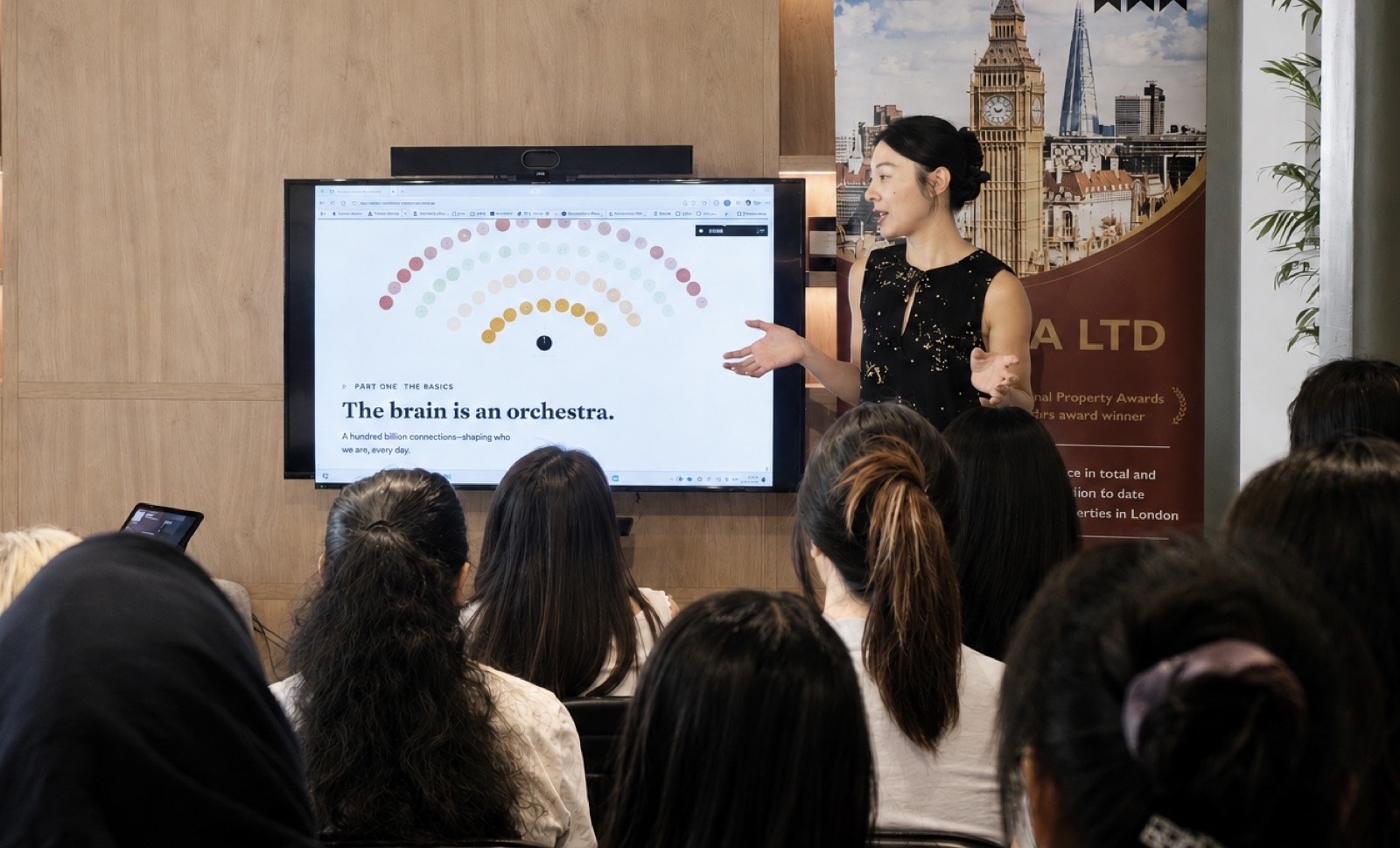
Most of us think of AI as a way to get more done. I built mine to protect the conditions for thinking.
Last Saturday I shared it at an AI hackathon pop-up in London. Thank you to She Nicest and Women in Science (WiNS) for the invitation.
The reasoning is simple. The brain thinks in parallel, like an orchestra. A person acts in serial: one word, one task at a time. So the scarce resource is not tools, and usually not time. It is energy. Every system I build starts there: guard the energy first, and output follows.
The brain is an orchestra. It can process many things in parallel, but I can only act on one line at a time. Speech, writing, work: one word, one task at a time. I was trying to manage two ventures, twenty lessons a week, training, money, content, and everything else through the same limited channel.
So I grew a second nervous system.
It works in parallel while I work in sequence. Different parts of the system record, remember, check, plan, and execute in the background. I keep only what actually needs me.
Five Voices, One System
My system has five parts: Apps, Knowledge, Judgment, Agents and Review.
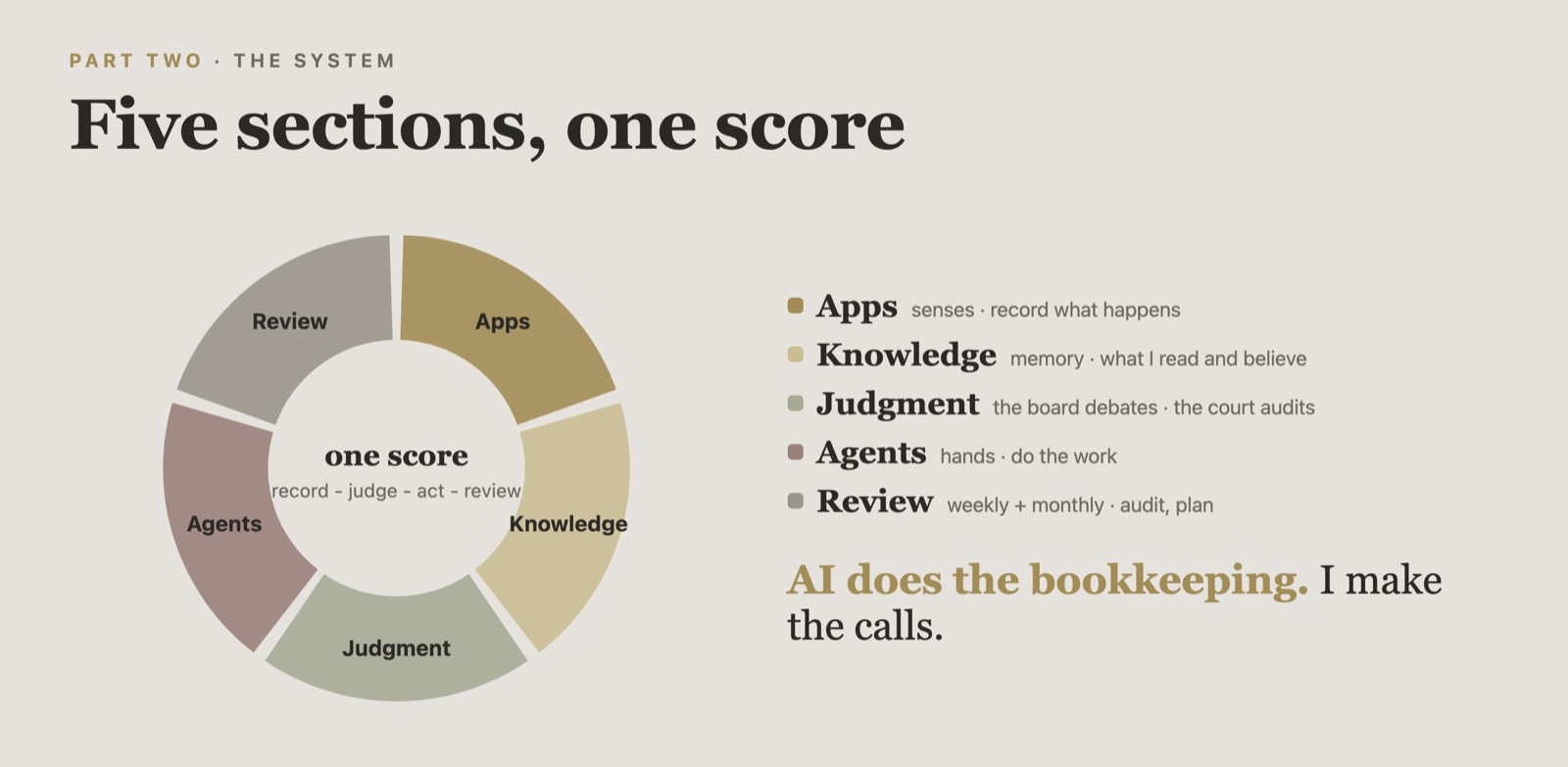
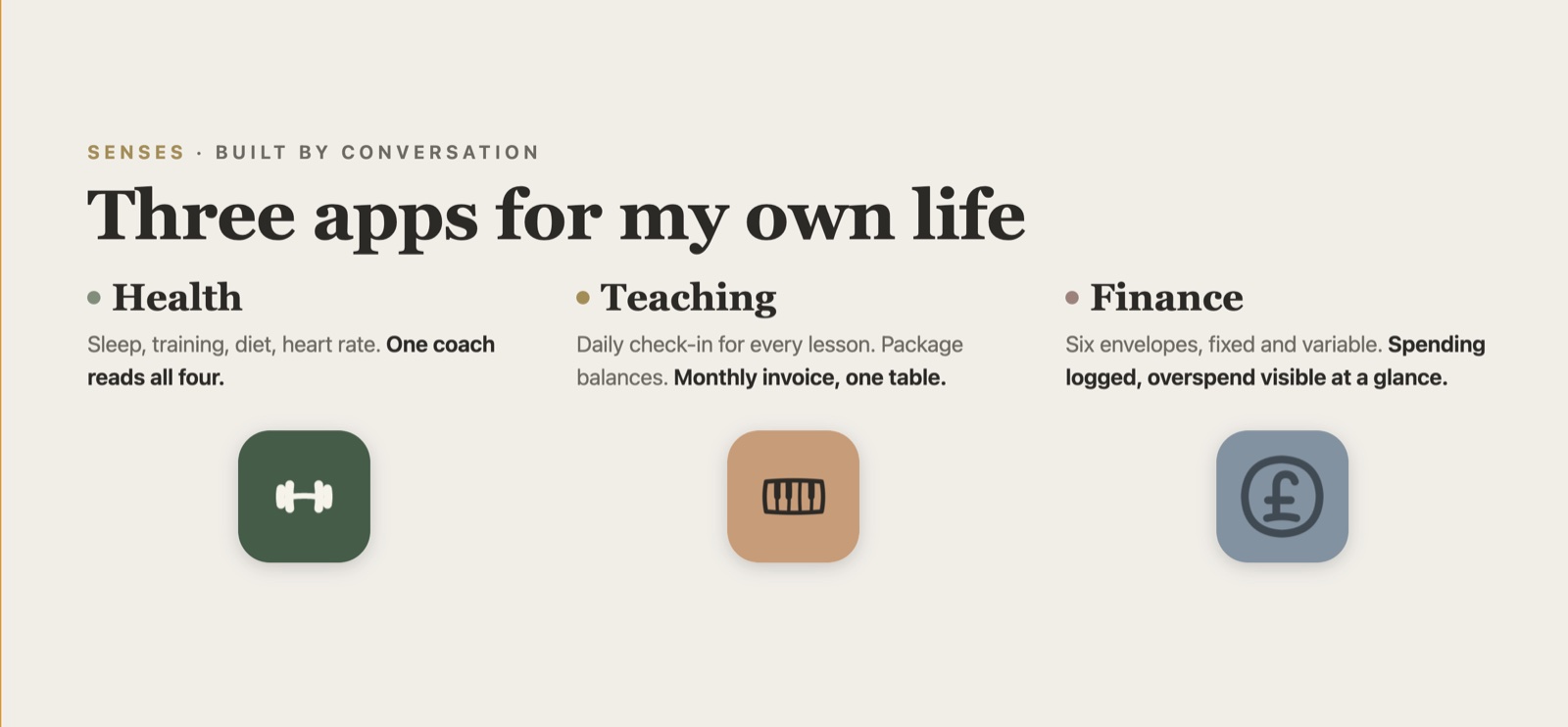
Apps open the system. They are its senses, recording what is actually happening in my life. There are three: Health, Teaching and Finance. Health gathers sleep, training, diet and heart rate in one place. Teaching holds lessons, student information, package balances and monthly invoices. Finance splits my spending across six accounts, so an overspend shows at a glance. The aim is not to collect more data. It is to make certain parts of my life visible enough that the system can respond to what is happening.
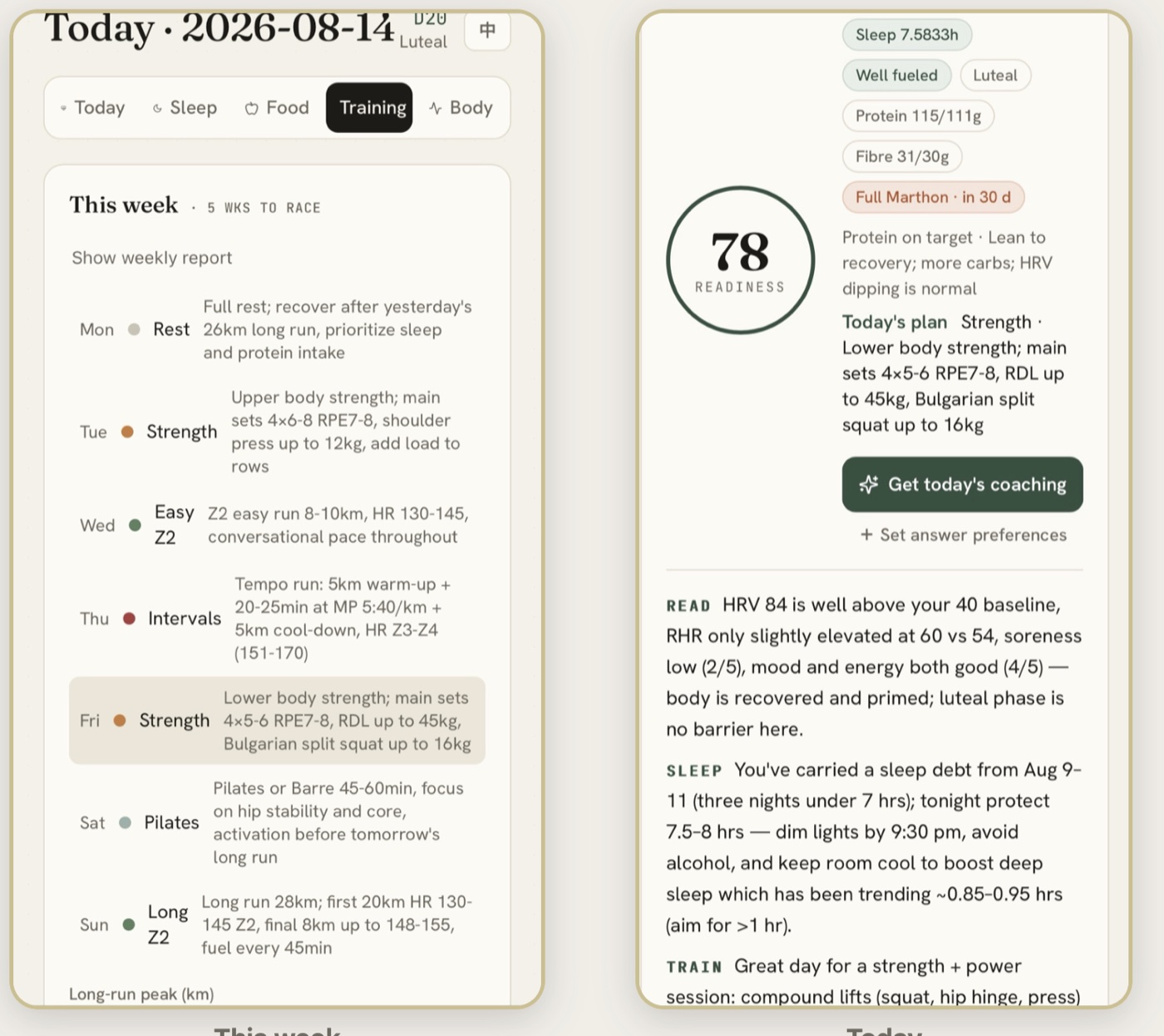
My running data is a good example. The health app connects to my Strava data, Apple Health data, and food logs, then uses them to create training plans and give me advice based on how my body is doing right now.
Knowledge is its memory. I use Obsidian for what I know and believe, and Notion for what I am running and planning. Obsidian holds the 22 books that have shaped me most, 172 interlinked core notes and 607 connections between them. Notion runs more than 30 students, two projects, weekly plans and a handful of working databases. Before an important decision, AI can read both and bring the relevant pieces back to me.
Judgment is the part I refuse to automate. For expensive or irreversible choices, I keep a Board and an AI Court. The Board brings different viewpoints to the table. The Court challenges assumptions, tests the evidence and looks for holes in the reasoning. For smaller calls that need no debate, I have written twelve explicit rules, so I do not have to reason through the same problem every time it returns.
An AI Court session in July 2026 also showed me the most important layer of the system. Three sceptics questioned, from different angles, whether my market execution was sustainable. Five witnesses provided information on cash flow, health, visibility, execution and support.
The conclusion was simple: the real bottleneck is not money, and not time, but the remaining capacity of my nervous system.
That sentence changed how I understand the whole system.
Agents are the hands. Fifteen of them: one runs continuously, around twenty run on a schedule, and a dozen advisors I can call when needed. They handle my calendar, shopping lists, financial checks, information sorting and the many small, repeating tasks.
My goal is not to automate everything in my life. It is to reduce the small decisions that keep draining my attention. Agents do the work. I make the decisions.
Review is where the loop closes. The work of the fifteen agents feeds a weekly review and a monthly deep clean. The weekly review looks back at what actually happened, what changed, what needs attention and what comes next. The monthly clean goes deeper, checking the whole system and resetting the plan for the next stretch.
So the whole system forms a loop: the system acts, the system records, the system reviews, and then the system changes.
To me, this loop matters more than automation itself.
The results are visible and checkable.
Muscle mass, 33.4 kg last April to 47.2 kg this July.
Long runs, 15 km in May to 26 km this month.
Fastest pace over 5 km, from 5:25 down to 5:16.
Resting heart rate, from 63 to 53 in six months.
The System Is Also a Way of Thinking
The most interesting part of building this system is that it changed my relationship with AI. My creative process usually starts with handwriting. I use handwriting to dig an idea deeper. Then I speak to bring out the full structure quickly and go wider. Finally, I let AI organise it into modules, rules and workflows.

When the system makes a mistake, I do not just fix that one error. I try to turn it into a rule and write it back into the system, so the same problem does not have to be solved twice.
The whole process is: Handwrite → Speak → Let AI structure → Mistakes become rules.
So technology is only part of it. More importantly, I am building a new way for my thinking and the system around it to work together.
The Part I Care About Most: The Conductor
We often think of the brain as a whole, as if it completes one unified task. But much of our cognitive activity comes from the dynamic cooperation between different large-scale brain networks.
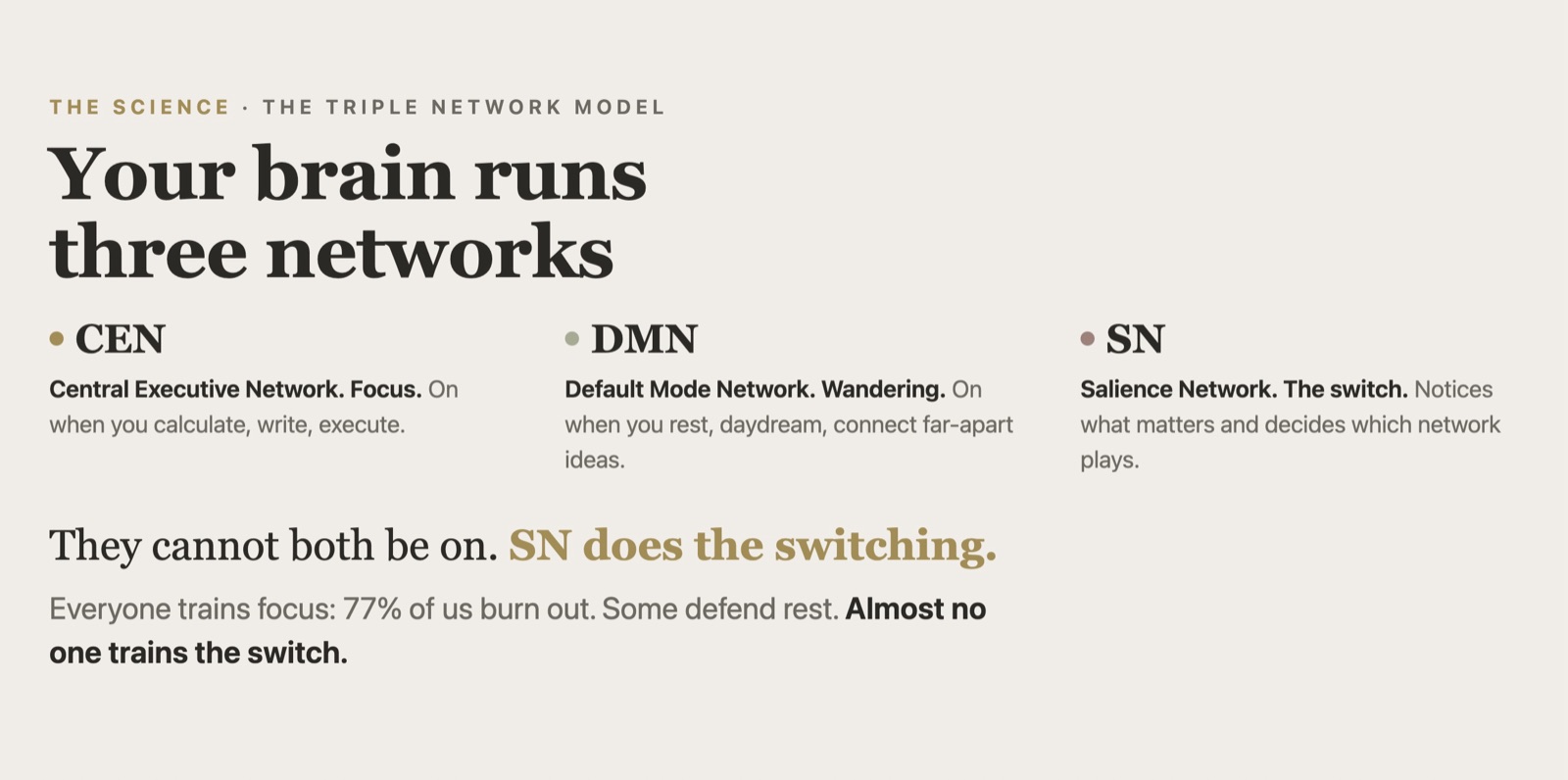
Very roughly, the Central Executive Network (CEN) is mainly involved in tasks that need focused attention, working memory and goal-directed effort. The Default Mode Network (DMN) is more involved in memory, imagination and mind-wandering. And the Salience Network (SN) helps us identify what matters most in the moment and plays a role in switching between cognitive networks and redistributing attention.
I think of the SN as a conductor.
This idea has an interesting parallel in the system I am building outside my brain. The problem is not that I need to keep myself focused all the time. Focus is only one state. Sometimes I need the CEN: writing, calculating, teaching, making decisions. Sometimes I need the DMN: wandering, making associations, connecting things that seem unrelated, imagining things that do not exist yet. And sometimes what I need to do is switch.
This is also what I think many modern productivity systems overlook. We are good at training focus and talking about deep work and efficiency. But constantly trying to stay in that mode can easily lead to burnout, so more and more people are recognising the importance of rest.
What interests me more is the transition between the two: when to do deep work, when to let the brain wander freely, and when I should stop making decisions because I no longer have enough capacity.
My second nervous system is really an attempt to externalise part of that switching.
To me, this is what a “second nervous system” really means. It is not meant to keep me running all the time. It helps me protect the energy that lets me think. As AI takes over more and more of the work of remembering, organising, searching and executing, what I want is not information, not tools, and not even just time, but the capacity to think.