Why I Wouldn't Recommend a Marathon to Most People
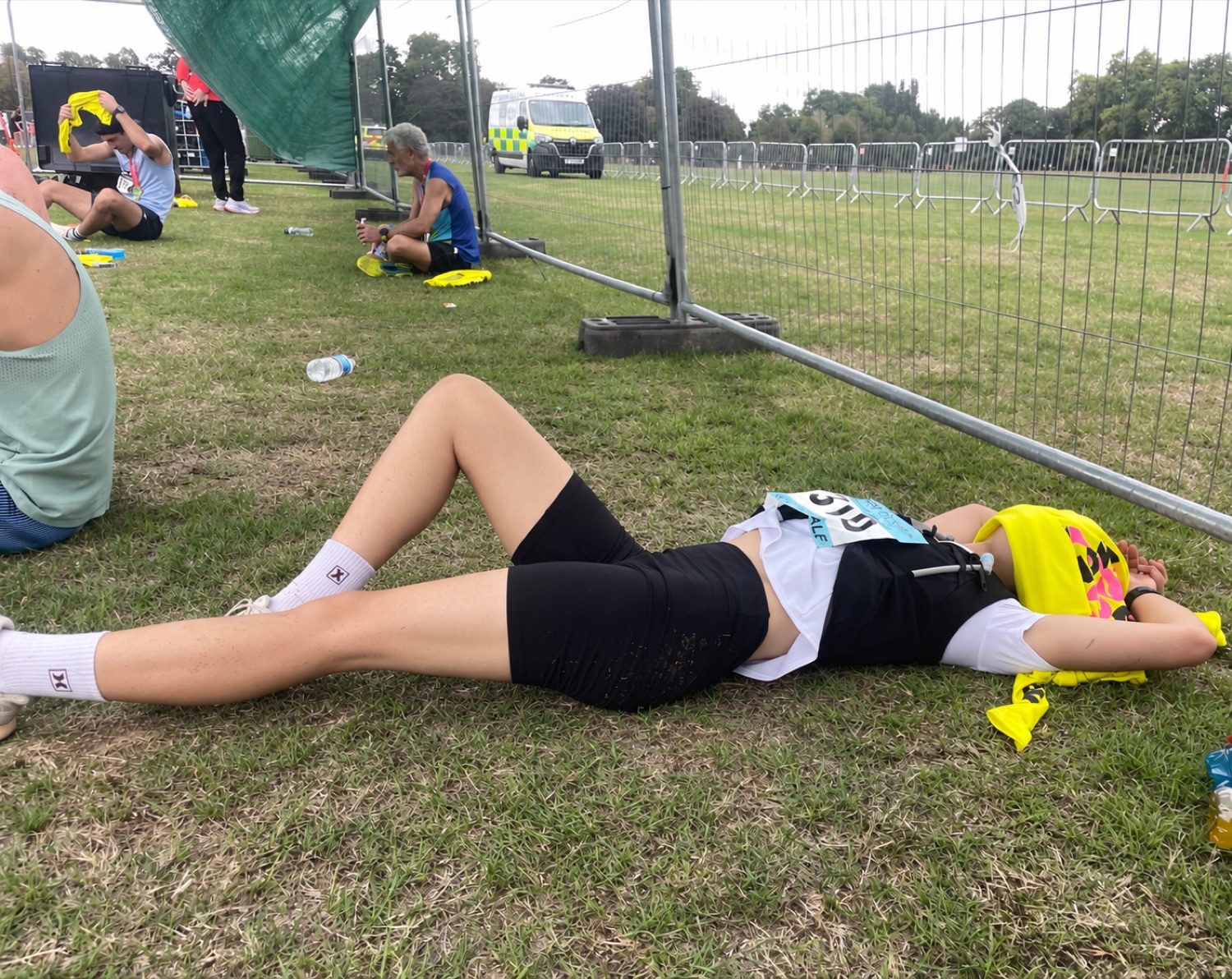
Last month, I ran a marathon.
42 kilometres took me about 4 hours and 40 minutes, including a stop for a bowl of beef noodles.
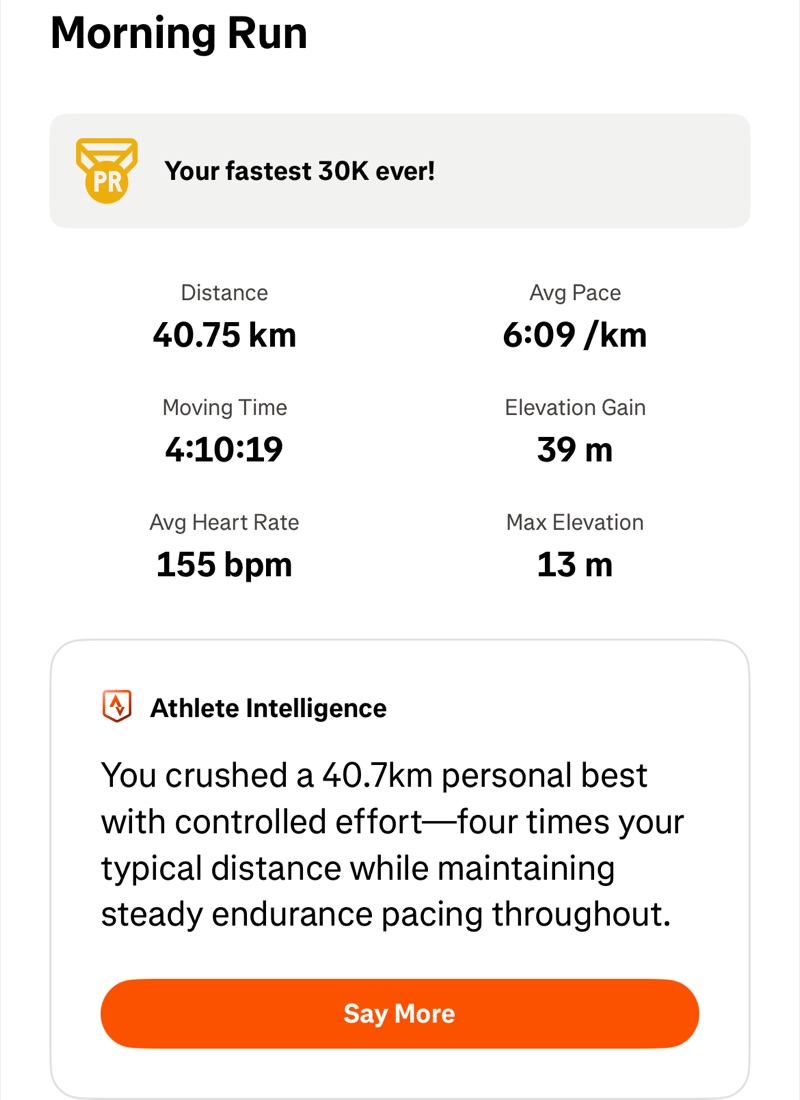
But from a longevity point of view, is running a marathon worth it?
If you only count the health benefits against the physical cost, a marathon is an expensive sport. You train for months, keep adding mileage, and pay a high recovery cost for the long runs. On race day, hours of continuous running put heavy loads on your muscles and joints, burn through large amounts of glycogen and other energy reserves, and ask a lot of your ability to recover.
Would I recommend it to the average person? Probably not. For most people, steady exercise, enough muscle mass and cardiovascular fitness, good sleep, a reasonable body fat level, and a decent diet matter more than chasing longer distances.
Still, I understand why so many people run marathons anyway.
Some things are hard to measure with health metrics. Can you stay with a long process that gives you no immediate feedback? Can you tell the difference between feeling tired in your head and being truly tired in your body, and make a decision in that moment? Can you reach the edge of your emotions when your body is pushed to its limit and still finish?
None of this maps to a single medical marker. But it makes up part of what I would call psychological resilience.
So I no longer see the marathon as a healthier way to live. I see it as an experience of testing the edges of body and mind.
Its value may not come entirely from the 42 kilometres. It also comes from what I learned about myself along the way.
Training Was a Trade-off
My preparation was not aggressive.
For about two months, I ran one long run of around 20 km every weekend. The longest was 26 km. I never ran 40 km in training because the recovery cost was too high. A 40 km session could affect my training for a week or longer, and over the whole cycle, it did not seem worth it.
So I chose consistent long runs that let my body adapt to long efforts gradually, while leaving enough room to recover.
That strategy also meant I had little experience of how my body would react after 30 km.
On race day, after 30 km, I ran into a problem I had not expected. I was so hungry that I could barely run.
I took two energy gels, but the hunger barely eased. In that state, my body wanted only hot food.
By then, I was completely worn out. It was raining, and all kinds of emotions kept rising. I knew exactly what stopping to eat would mean.
Then a voice told me to let go of the numbers.
So when I saw a stall on the road, I stopped and ate a bowl of beef noodles.
It sounds funny now. But it took more courage than any training run I have done, and I had to keep reminding myself what mattered most.
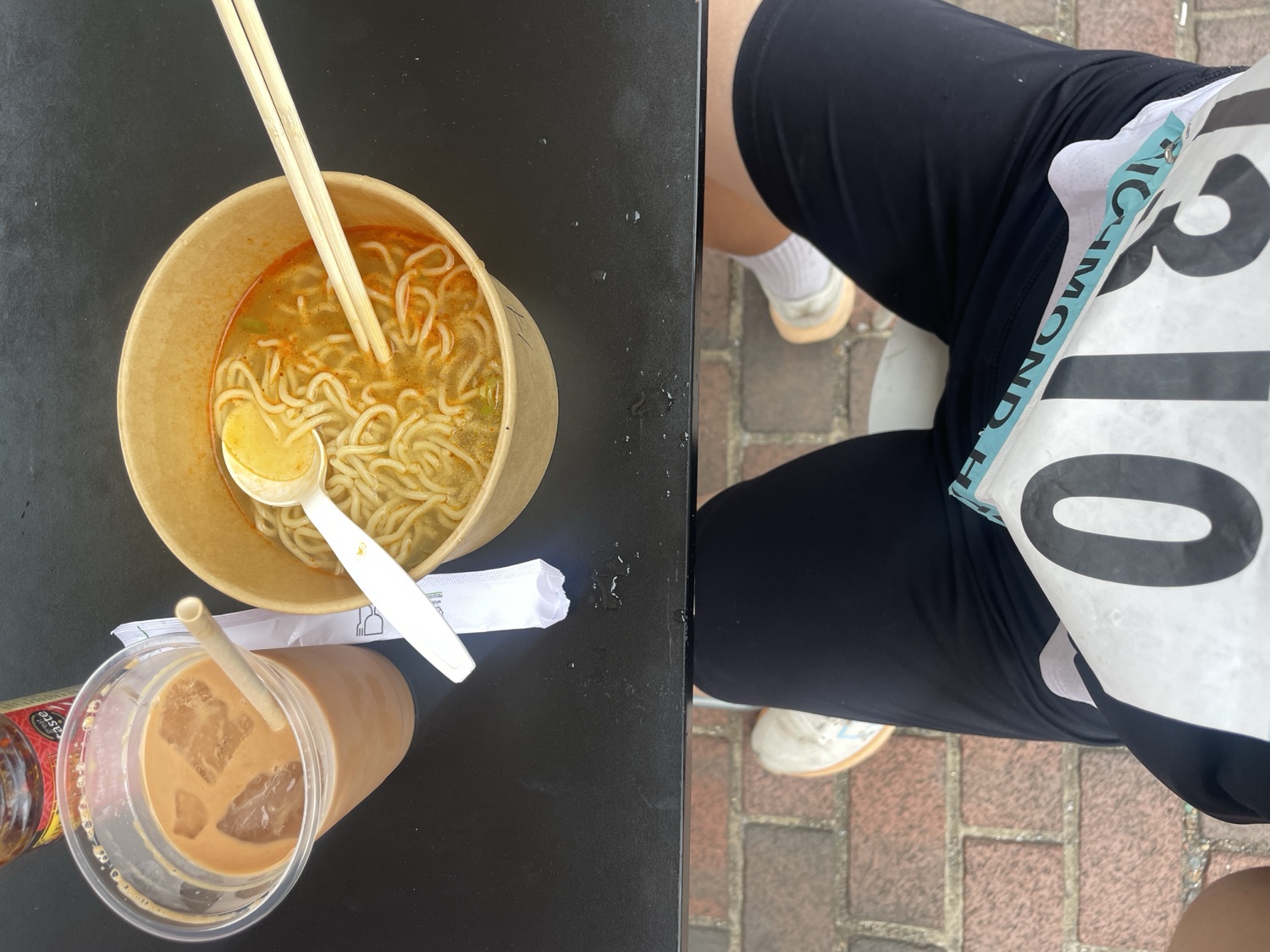
Looking back, it taught me something very concrete about long-distance running.
Sports nutrition has plenty of general principles. Endurance exercise needs a steady supply of carbohydrates, and trained endurance athletes can gradually increase their carbohydrate intake and gut tolerance through training.
But in a real race, when you get hungry, whether to push through the hunger, and when a gel stops helping, are things you only learn from your own training. Beyond three hours, individual differences become huge. Everyone needs a different fuelling strategy and has a different experience of their body.
So long-distance training is also a way of getting to know your own body.
This race showed me more clearly that the limits of the body and the limits of the mind are hard to separate.
When the physical challenge approaches its breaking point, what rises first is rarely rational analysis. It is a set of very specific and sometimes uncontrollable emotions: irritation, frustration, pain, and the urge to quit.
In that state, the thinking and reasoning we normally rely on seem to step back, and emotion gets very loud.
Maybe this is why the best athletes train the mind as seriously as they train the body.
Real training may never be only about the body.
To some extent, I see sport as training in how to be with your own emotions.
Long Runs Do Not Have to Run on Willpower
There is one more thing I found by accident during training.
Once a run goes past two or three hours, it becomes very long. Most of the time, you run alone, and your body keeps repeating the same movement. If you only think of it as, “I have to finish 20 km,” it gets boring quickly.
So I decided to turn my weekend long runs into exploration.
Every weekend, I tried to run somewhere different. Sometimes it was a park I had never been to. Sometimes I picked a route that passed an exhibition or a small shop I had never walked into. Sometimes I ran somewhere and then went nearby for a good meal.

That way, a “20 km long run” stopped being a training task and became a small city adventure.
My reason for going out changed. I wanted to see somewhere new, and running 20 km was just the way I got there.
That change mattered a lot. Something that used to need willpower became something I looked forward to every weekend. I would think ahead: Where should I go this week? What is there? What will I eat afterwards?
It may also be the first time I clearly felt that staying with something for a long time does not necessarily require stronger willpower. Sometimes, the better move is to redesign the thing so that it becomes interesting in itself.
This applies to a lot of things. If a behaviour needs you to force yourself every single time, it rarely becomes a lasting habit. If you can connect it to exploration, curiosity, or something else you already enjoy, sticking with it gets much easier.
Heart Rate Over Pace
About 80% of my running during preparation was in Zone 2.
For the first two years, I paid attention to pace. Since last year, I have felt more and more that heart rate tells me more than pace does. Pace is an external result. Heart rate is closer to the physical load my body is carrying right now.
Put simply, pace is for other people to see. Heart rate is about me.
The same 5:30 per km can feel easy on a cool day when I have slept well and feel good. On a hot day, after a bad night, or after a few days of built-up fatigue, the same pace can push my heart rate up noticeably.
Terrain matters too. On a climb, your speed drops, but the load on your body may already have gone up. If you keep staring at pace, it is easy to speed up just to hold the number, and quietly push your effort past the target.
We usually split heart-rate training into five zones. Zone 1 is very easy recovery work, typically used for warming up, cooling down, and recovery. Zone 2 is low-intensity aerobic work that you can sustain for a long time, and it is an important zone for building an aerobic base. In Zone 3, the intensity rises noticeably, and breathing gets deeper and faster. Zone 4 moves closer to the lactate threshold, where the effort becomes much harder to sustain. Zone 5 is near-maximal effort, closer to speed, power, and maximum cardiovascular capacity, and you can only hold it briefly.
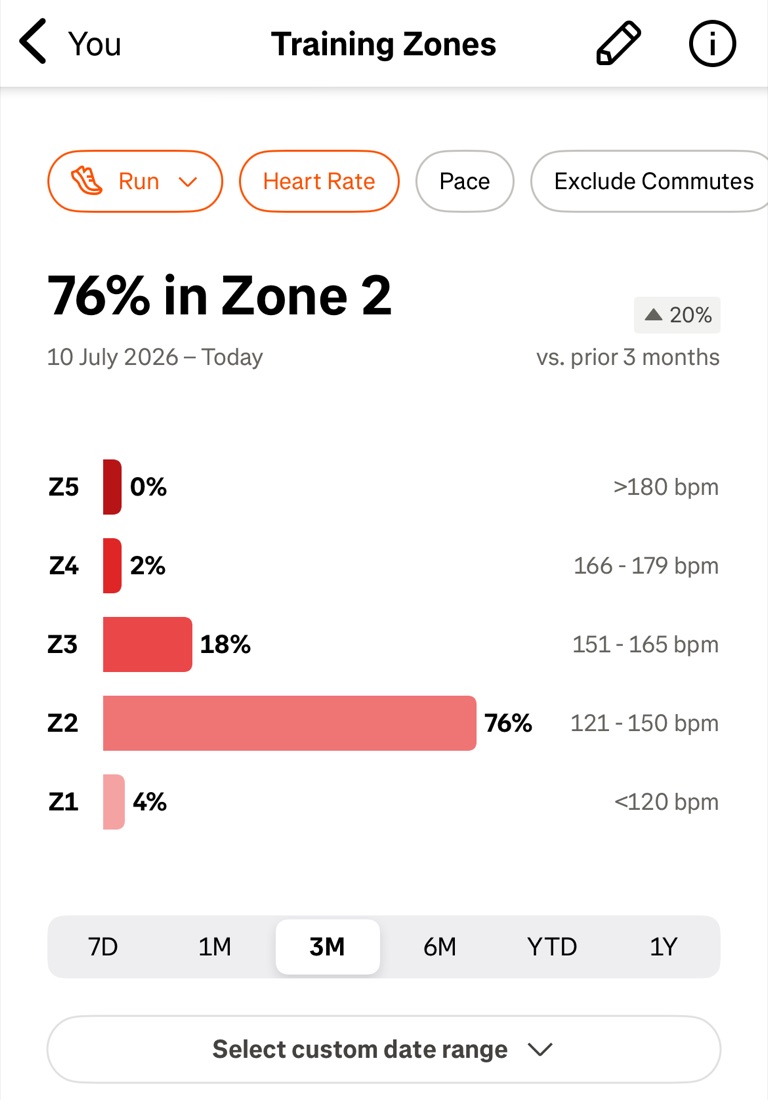
I especially like Zone 2 because it sits at an interesting balance point. It is hard enough to give the body a real aerobic training stimulus, and easy enough to keep going for a long time, with a relatively low recovery cost.
For people who build mileage over the long term, that means you can train again and again without needing long breaks to recover.
This is also why I did not stack up Zone 3, Zone 4, and Zone 5 during preparation. High-intensity work has its value. But if every session chases a faster pace, it is easy to push the body into a state that needs a long time to recover.
A marathon needs accumulated training volume, and I cared more about whether the whole training cycle could keep going steadily.
So heart-rate training feels to me like asking one question:
In Zone 2, what I care about is whether I am staying at an effort I can keep up. A simple check by feel: I can still speak normally while running, my breathing is steady, and I do not need a long time to recover afterwards.
This kind of training looks slow, but it trains one very important ability: whether the body can supply aerobic energy for a long time.
That is where I began to really understand Zone 2.
What Does Zone 2 Have to Do With Mitochondria?
Think of the human body as a system that needs a constant supply of power. Mitochondria can be understood as the energy factories inside our cells.
The carbohydrates, fats, and other nutrients we eat go through a series of metabolic processes, including aerobic metabolism involving the mitochondria, to produce ATP. ATP can be understood as the form of energy cells use directly.
Muscles need to keep producing ATP during long exercise. So the number, function, and oxidative capacity of mitochondria all contribute to our endurance and ability to sustain energy production.
Regular, low-intensity aerobic training like Zone 2 is one of the main ways the body builds more and better mitochondria in the muscles. That is why I spend most of my running time there.
If we want our bodies to last many years, what matters most may be keeping our aerobic system in good working condition over the long term.
Running a marathon once in a while can test your limit.
What daily training builds is the body's ability to keep working when it is not being pushed to the limit.
The Question the Marathon Left Me
Seen this way, a marathon is a very concentrated experiment. In a few hours, it gave me fatigue, hunger, fuelling, resilience, and the limits of my body. It also made me look again at the less exciting training I do every day, and at the steadier state of mind that comes with it.
More worth thinking about than the number 42.195 km is this: how to train, how to recover, how to eat, and how to live with my own body and brain, so that all of it becomes something I can keep doing for decades.
But why do I still want to do this now and then?
I want to see where my emotional edge is when my body is pushed to its limit.